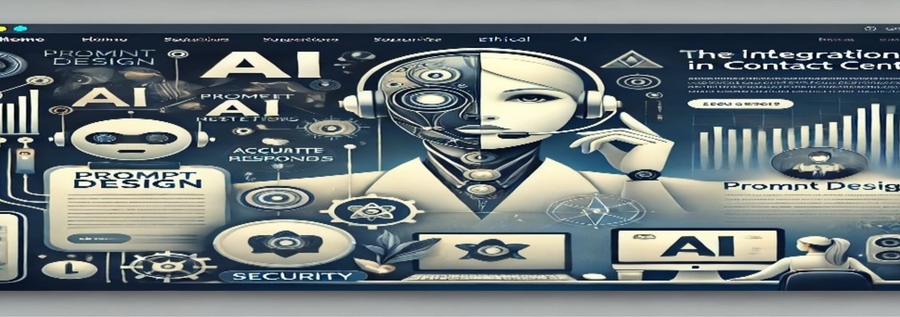
Self-protective Auto-improvised Contextual Prompt Infrastructure for Webex Contact Center
developer.ciscospark.com ciscospark.com
This is what was read here when it was published. Anupam Mukherjee no longer carries it in what it publishes now.
Listen to this summary
This blog delves into the vital role of Large Language Models (LLMs) in Webex Contact Center, highlighting the significance of precise prompt design for ensuring accurate, relevant, and secure AI interactions. It presents an advanced prompt infrastructure that adapts to specific tasks, optimizing LLM performance while incorporating multi-layered guardrails to prevent issues like hallucinations and prompt injection attacks. Although the focus is on Webex Contact Center, the principles and practices discussed are broadly applicable to any AI-driven application in Cisco, including collaboration tools, where the reliability and ethical use of LLMs are paramount while being used for generative…
As Large Language Models (LLMs) become increasingly central to AI-driven applications, especially in Webex Contact Center, the design of effective prompts is critical. These prompts not only guide LLMs to produce accurate and contextually relevant responses but also ensure the AI operates within ethical and secure boundaries. The advanced prompt infrastructure discussed here exemplifies how LLMs can be tailored to specific tasks, enhancing both performance and reliability. While this write-up emphasizes the importance of precise prompt design in Webex Contact Center, the principles are equally applicable to other areas, such as collaboration, where LLMs are used for various generative tasks.
More ways to use this
Open on another device

Scan to open this page. Your saved notes and account access are not included.
 U.S. urges critical infrastructure orgs to secure refrigeration systems ASAP after EU supermarket and blood bank attacks
 Whole-of-state defense: How SLED agencies can secure critical infrastructure in the AI era
 Forgotten Space Live at AT&T Performing Arts Center on 2024-09-27